The End of Page 1: How AI Is Rewriting the Rules of Online Visibility
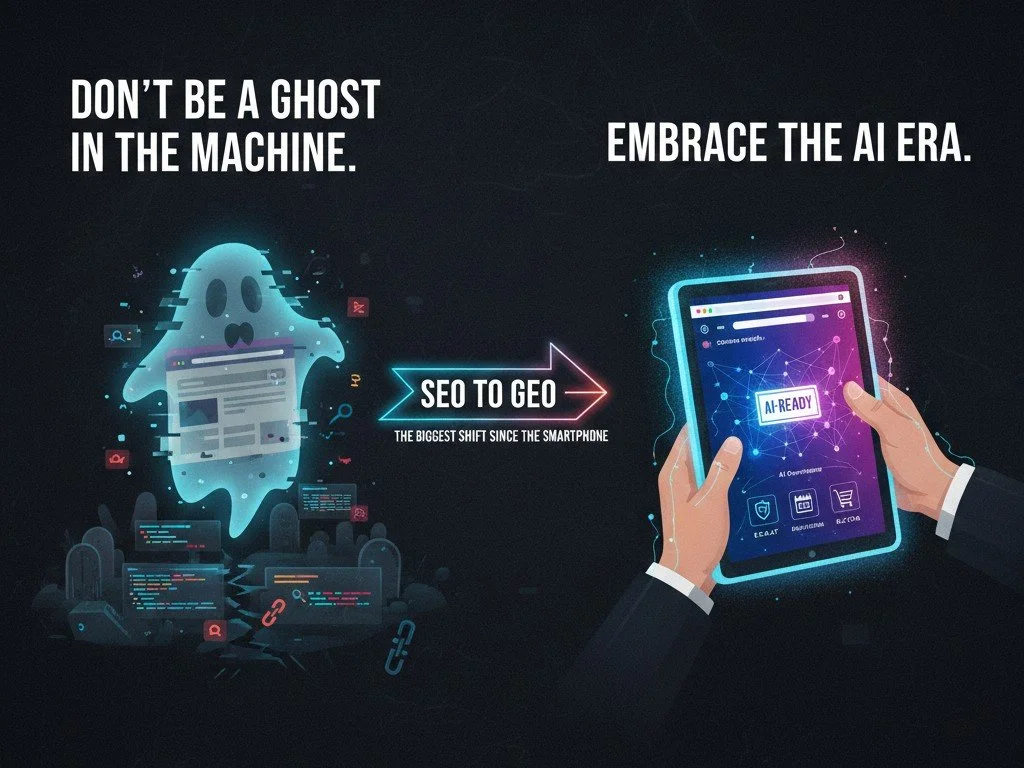
For decades, the goal of a website was simple: rank on Page 1 of Google and get the click. But as we move through 2026, the digital landscape has shifted beneath our feet. The "search bar" is no longer the undisputed gateway to the internet.
Today, that gateway is a fragmented world of AI Overviews, ChatGPT-powered research journeys, and autonomous AI agents. In this new era, your website isn’t just a brochure for humans—it’s a data source for machines.
If your site isn't AI-Ready, your business isn't just buried; it's invisible.
The 2026 Reality: From Clicks to Citations
In the old world of SEO, we fought for "blue links." In 2026, we fight for eligibility.
Search has evolved into Generative Engine Optimization (GEO). Most users now receive synthesized answers directly on their screens. AI models like Gemini and Perplexity scan the web to curate a shortlist of recommendations. If the AI doesn't find your data credible or readable, it won't just rank you lower—it will leave you out of the conversation entirely.
The impact is binary: You are either the brand the AI trusts to solve the user's problem, or you don't exist.
1. Structure is the New Creative
In 2026, "clean code" means more than fast loading speeds. It means Machine Legibility. AI agents don’t "browse" your site; they parse it for specific entities and intent.
Advanced Schema Markup: Using JSON-LD is no longer optional. You must explicitly define your services, pricing, and FAQs. If an AI agent is looking for a "reliable plumber in New Brockton," it shouldn't have to guess your service area; it should see it in your structured data.
Actionable CTAs: Your "Book Now" button needs to be more than a pretty color. It needs OrderAction or ScheduleAction schema so an AI agent can actually execute the task for the user.
2. Authority Over Keywords
The days of "keyword stuffing" are in the history books. AI in 2026 is obsessed with E-E-A-T (Experience, Expertise, Authoritativeness, and Trustworthiness).
AI models cross-reference your site with the rest of the web. They look for:
Original Research: Data that only you have.
Verified Credentials: Clear author bios and third-party citations.
Consistent Sentiment: What are people saying about you on Reddit, LinkedIn, or industry forums? AI aggregates this "consensus" to decide if you are worth recommending.
3. Solving the "Zero-Click" Problem
You’ve likely noticed that website traffic looks different this year. While total clicks might be down, the intent of the visitors you do get is at an all-time high.
An AI-Ready website treats the AI as a high-level salesperson. The AI handles the "what" and "why," while your website handles the "how" and "how much." When a user finally clicks through to your site in 2026, they aren't just "looking around"—they are ready to convert because the AI has already pre-vetted you.
Is Your Site Ready for the AI Era?
The transition from SEO to GEO is the biggest shift in digital marketing since the invention of the smartphone. Being "found" in 2026 requires a website that speaks the language of the algorithms while maintaining the soul of a human-centric brand.
Don't let your business become a ghost in the machine.